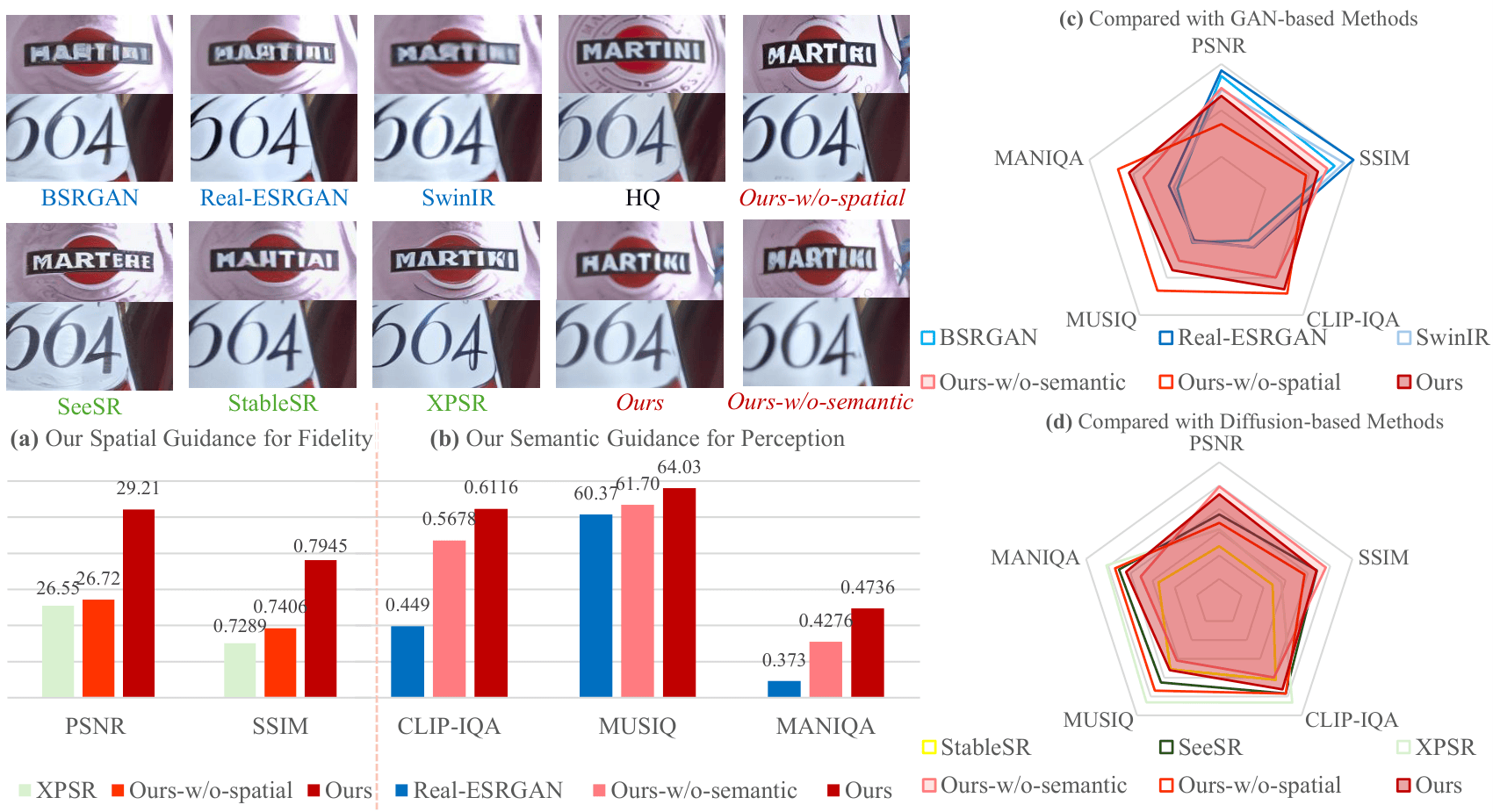
Image super-resolution (SR) aims to reconstruct high resolution images with both high perceptual quality and low distortion, but is fundamentally limited by the perception–distortion trade-off. GAN-based SR methods reduce distortion but still struggle with realistic fine-grained textures, whereas diffusion-based approaches synthesize rich details but often deviate from the input, hallucinating structures and degrading fidelity. This tension raises a key challenge: how to exploit the powerful generative priors of diffusion models without sacrificing fidelity. To address this, we propose SpaSemSR, a spatial–semantic guided diffusion framework with two complementary guidances. First, spatial-grounded textual guidance integrates object-level spatial cues with semantic prompts, aligning textual and visual structures to reduce distortion. Second, semantic-enhanced visual guidance with a multi-encoder design and semantic degradation constraints unifies multimodal semantic priors, improving perceptual realism under severe degradations. These complementary guidances are adaptively fused into the diffusion process via spatial-semantic attention, suppressing distortion and hallucination while retaining the strengths of diffusion models. Extensive experiments on multiple benchmarks show that SpaSemSR achieves a superior perception-distortion balance, producing both realistic and faithful restorations.